Introduction
In today’s rapidly evolving business environment, organizations are faced with increasingly complex decisions. From strategic planning to operational management, the ability to make informed and timely decisions is essential for achieving sustainable growth and maintaining a competitive advantage.
Artificial Intelligence (AI) is transforming the way organizations analyze information, evaluate opportunities, and approach decision-making. By combining advanced data analysis with human expertise, AI provides valuable insights that support more effective business strategies.
However, the true value of AI lies not in replacing human judgment, but in enhancing it.
The Role of AI in Modern Decision-Making
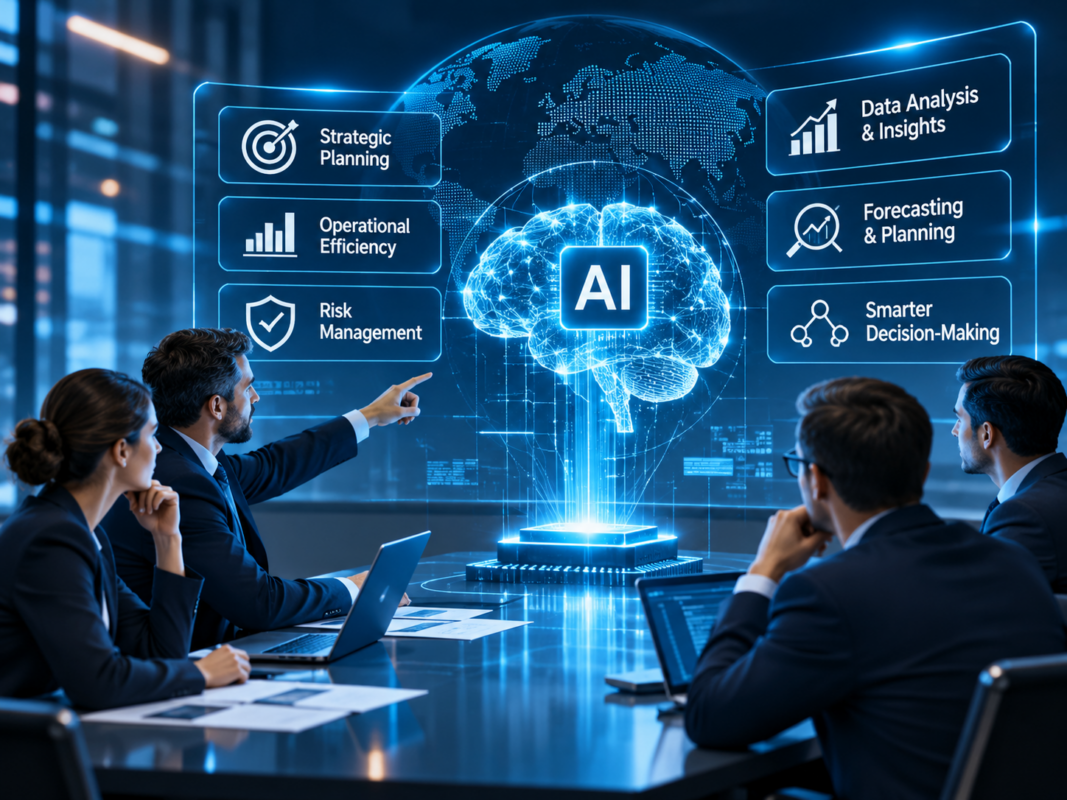
Artificial intelligence enables organizations to process large volumes of data, identify patterns, and generate insights that may otherwise remain unnoticed.
Traditional decision-making often relies on historical data, experience, and manual analysis. While these methods remain valuable, AI can significantly improve the speed and depth of analysis.
AI-powered tools can support organizations in:
- Analyzing complex business data
- Identifying trends and potential risks
- Improving forecasting and planning
- Evaluating strategic alternatives
- Supporting operational decision-making
These capabilities allow decision-makers to gain a clearer understanding of their business environment and make more informed choices.
AI in Strategic Decision-Making
Strategic decisions have a long-term impact on an organization’s direction, performance, and growth.
AI can support strategic planning by analyzing market trends, evaluating business performance, and identifying emerging opportunities.
Organizations can use AI-driven insights to assess different scenarios, anticipate potential challenges, and develop more effective strategies.
Nevertheless, successful strategic decision-making requires more than data analysis. Industry knowledge, leadership experience, and a clear understanding of organizational objectives remain essential.
AI should therefore be considered a strategic support tool rather than an independent decision-maker.
Improving Operational Efficiency Through AI
AI also plays a significant role in improving operational performance.
Organizations can leverage AI to identify inefficiencies, optimize workflows, and enhance resource allocation. Predictive analytics can help anticipate operational challenges, while intelligent automation can reduce repetitive tasks and improve consistency.
In sectors such as defense and logistics, these capabilities can be particularly valuable.
AI-supported planning can contribute to better coordination, improved process visibility, and more efficient management of complex operational environments.
By integrating AI into operational processes, organizations can strengthen their ability to respond to changing requirements.
AI and Risk Management
Effective decision-making requires a clear understanding of potential risks.
AI can help organizations identify patterns associated with operational disruptions, financial uncertainty, and process inefficiencies.
Through predictive analytics and scenario modeling, businesses can evaluate potential outcomes and develop appropriate mitigation strategies.
However, AI-generated insights should always be assessed within the broader organizational context. Data quality, model limitations, and human oversight are important factors in ensuring reliable results.
A structured approach to AI-supported risk management can improve organizational resilience and decision confidence.
The Importance of Human Expertise
Despite its capabilities, AI cannot replace the experience, judgment, and accountability of skilled professionals.
Human expertise remains essential for interpreting results, understanding organizational priorities, and making decisions that involve complex business considerations.
The most effective approach combines technological capabilities with practical experience.
Organizations that successfully integrate AI into their decision-making processes are those that establish a balance between data-driven insights and human judgment.
How MAK Ai Supports Better Decision-Making
At MAK Ai Consultancy & Advisory, we believe that effective decision-making begins with a clear understanding of organizational challenges and objectives.
We combine strategic insight, operational expertise, and a results-driven approach to help organizations navigate complexity and identify practical solutions.
Our advisory services support organizations in improving processes, strengthening operational performance, and translating strategic objectives into actionable plans.
As AI continues to evolve, we recognize its potential to enhance analysis, support planning, and improve organizational effectiveness.
Our focus remains on applying the right expertise and methodologies to create meaningful and sustainable business outcomes.
Conclusion
Artificial Intelligence is becoming an increasingly valuable tool for modern organizations. By improving data analysis, supporting strategic planning, and enhancing operational efficiency, AI can contribute to better decision-making across different business functions.
However, successful implementation depends on combining technology with human expertise, clear objectives, and effective management.
Organizations that adopt a thoughtful and structured approach to AI will be better positioned to navigate complexity, respond to change, and achieve sustainable success.
MAK Ai Consultancy & Advisory — Strategic Insight. Operational Excellence. Sustainable Results.